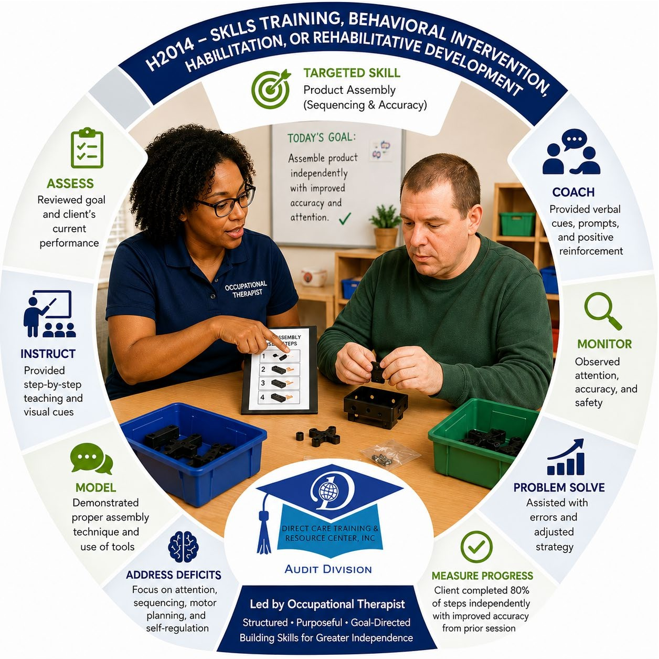
Within the Michigan No-Fault environment, the use of billing systems that align with electronic clearinghouses can provide substantial operational advantages for rehabilitation providers, residential programs, and therapy organizations. Clearinghouse-compatible systems improve billing efficiency through standardized claim formatting, electronic submission tracking, error detection, denial monitoring, remittance processing, and streamlined reimbursement communication between providers and insurers. These systems can reduce clerical mistakes, improve turnaround times for payments, create organized audit trails, and allow providers to better monitor procedural code utilization, authorization periods, and outstanding receivables. In highly complex catastrophic claims involving multiple disciplines such as occupational therapy, behavioral intervention, attendant care, vocational rehabilitation, and cognitive rehabilitation, organized billing infrastructure becomes extremely important for maintaining continuity and administrative accountability.
However, the existence of a sophisticated billing platform does not eliminate the legal and clinical necessity of ensuring that the actual services rendered align with the procedural code billed. Electronic billing systems are administrative mechanisms, not substitutes for medical necessity, qualified personnel, or compliant service delivery. In Michigan No-Fault cases, insurers and the Michigan Catastrophic Claims Association (MCCA) continue to maintain the authority to internally review claims for appropriateness, legitimacy, documentation sufficiency, provider qualifications, and consistency between the billed code and the intervention performed.
A clearinghouse may successfully transmit and even temporarily facilitate payment for a claim, but that does not validate whether the billed procedure was clinically justified or properly supported.
If a code such as H2014, 97129, S5125, or another rehabilitative service code is used, documentation must still establish that the billed intervention actually occurred and was delivered by personnel operating within the appropriate educational, credentialed, supervisory, and legal framework. For example, if a rehabilitative or behavioral code implies structured skills training, habilitation, or therapeutic intervention, the documentation must demonstrate active teaching, correction, monitoring, and measurable functional development rather than generalized supervision or companionship. Likewise, if occupational therapy-related interventions are being referenced, the session should reflect involvement, oversight, or structured delegation consistent with accepted standards of rehabilitative practice.
Michigan No-Fault carriers and MCCA reviewers frequently examine whether the personnel involved possessed the training and role necessary to perform the services represented by the code billed. They may also evaluate whether the documentation reflects true skilled intervention versus non-billable routine support services disguised within therapeutic terminology.
As a result, providers should understand that billing software and clearinghouse acceptance create a smoother highway for claim submission, but the vehicle itself must still be legally roadworthy. Proper staffing, accurate procedural code selection, medical necessity, individualized treatment planning, and defensible documentation remain the foundation upon which reimbursement ultimately stands. Even after payment is issued, internal insurer audits, utilization reviews, examinations under oath, peer reviews, and MCCA scrutiny may still challenge claims if documentation does not adequately support the services rendered. In catastrophic care environments where long-term costs can become substantial, documentation integrity is not merely an administrative preference; it becomes a significant legal and financial protection mechanism for both the provider and the injured individual receiving care. •
Another Blog Post by Direct Care Training & Resource Center, Inc. Photos used are designed to complement the written content. They do not imply a relationship with or endorsement by any individual nor entity and may belong to their respective copyright holders.
| Follow us in the Social Stratosphere… | ||||
|


