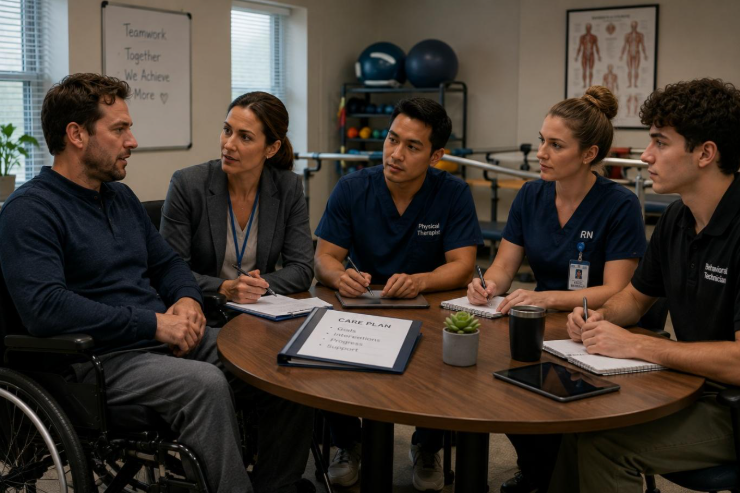
Michigan’s no-fault insurance system has never lacked tension between cost containment and the obligation to provide reasonably necessary care to catastrophically injured individuals. That tension appears to be sharpening again as insurers increase scrutiny of medical case management billings, a move many within the post-acute care industry believe could create unintended consequences far more expensive than the services being questioned.
Recently, Hanover Insurance Group circulated correspondence announcing planned scrutiny of case management activities and billings, referencing “market activity comparisons” as part of its review methodology. While insurers undoubtedly possess the right to investigate potentially excessive or unnecessary charges, the phrase itself raises substantial questions within Michigan’s no-fault community.
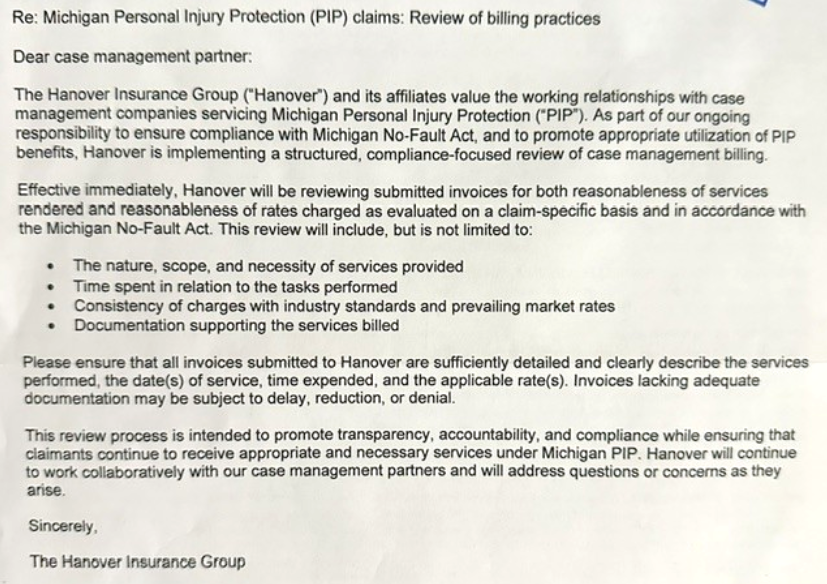
Specifically, how does an insurer accurately compare the value and necessity of medical case management services across catastrophically injured populations whose clinical, behavioral, psychological, and environmental circumstances vary dramatically from case to case?
Under Michigan’s no-fault framework, catastrophically injured claimants remain entitled to reasonably necessary products, services, and accommodations for care, recovery, or rehabilitation. Medical case management has historically served as one of the central organizing forces in complex claims. In many situations, the case manager is not simply a scheduler or administrative intermediary. Rather, the case manager becomes the connective tissue holding together rehabilitation providers, physicians, behavioral specialists, residential facilities, family members, transportation arrangements, medication compliance efforts, and attendant care services.
This becomes especially important in behavioral and neuropsychological injury cases where regular involvement and scheduled visibility can substantially reduce destabilizing events. Experienced case managers often identify escalating behaviors before they become emergencies. They coordinate medication adherence, intervene during refusals of care, arrange crisis de-escalation, and maintain communication between providers who otherwise operate in silos.

The economic implications of this role are significant. A proactive case manager who prevents repeated emergency room visits, psychiatric admissions, or prolonged behavioral hospitalizations may save insurers tens or even hundreds of thousands of dollars annually. The challenge, however, is that these avoided costs are often invisible on a spreadsheet. There is no billing code for the psych admission that never occurred or the violent behavioral episode that was prevented through early intervention and consistent oversight.
That reality makes so-called “market activity comparisons” particularly difficult to evaluate objectively. What exactly constitutes a comparable case? Is a traumatic brain injury case involving medication refusal and behavioral dysregulation truly comparable to a physically injured claimant with stable family support and minimal cognitive impairment? Can one compare an individual residing in a structured residential setting with another attempting community reintegration? Does frequency of contact alone establish excessiveness, or must the analysis account for the complexity and volatility of the injured person’s condition?
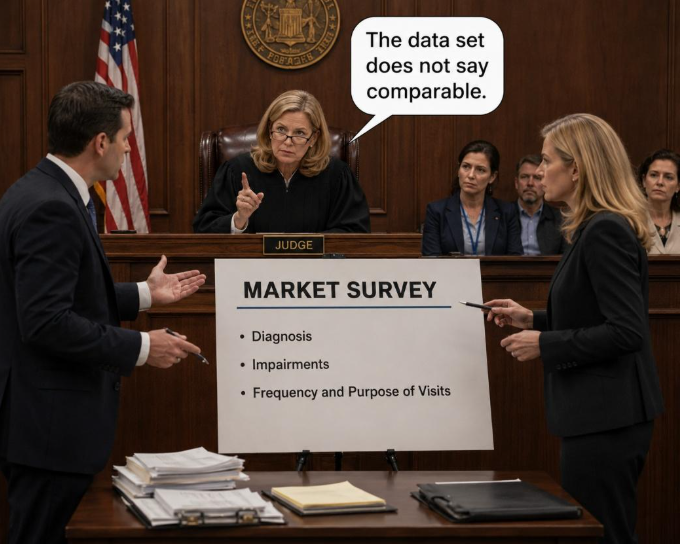
If insurers intend to rely on market comparisons in litigation, those comparisons may eventually require rigorous evidentiary support.
Courts could reasonably ask whether the allegedly comparable claims involve substantially similar diagnoses, behavioral histories, treatment plans, supervision requirements, geographic provider limitations, family dynamics, and rehabilitation goals. Without such specificity, generalized references to “market activity” risk appearing less like objective benchmarking and more like broad cost-reduction language untethered from clinical realities.
There is also growing concern among providers that case management may represent an attractive target precisely because its billings are often smaller than those generated by residential facilities, rehabilitation programs, transportation services, and attendant care agencies. In the broader ecosystem of catastrophic care, case management expenses can appear modest. Yet reducing or destabilizing that oversight function may ultimately increase exposure elsewhere by allowing fragmentation, preventable crises, and unnecessary institutionalization to develop unchecked.
Many within the industry believe that if widespread reductions or denials emerge, the case management community is unlikely to remain fragmented. Multiple companies operating collectively, supported by experienced legal counsel and industry advocacy, could mount significant challenges to any insurer practices perceived as improperly undermining legitimate services.
The Michigan Department of Insurance and Financial Services (DIFS) may also become an important focal point in this debate. If insurers rely upon “market facts” or comparative utilization data to reduce payments, stakeholders may demand transparency regarding how those comparisons were constructed, what datasets were used, whether the comparisons accounted for case complexity, and whether the methodology satisfies standards of fairness and accuracy under Michigan law.
At its core, the issue is not whether insurers may investigate abuse. They can and should. The larger question is whether legitimate, clinically necessary case management services can be fairly evaluated through generalized market comparisons in a system where no two catastrophic injury cases are truly alike.
In the end, Michigan’s no-fault system may once again find itself balancing two competing imperatives: controlling costs while preserving the very coordination mechanisms that often prevent catastrophic care from becoming even more costly.


Another Blog Post by Direct Care Training & Resource Center, Inc. Photos used are designed to complement the written content. They do not imply a relationship with or endorsement by any individual nor entity and may belong to their respective copyright holders.
| Follow us in the Social Stratosphere… | ||||
|


